-


- A new species described by Cabral,
Villareal and Estrada in Act. Bot. Mexicana 80: 51-57 (2007).
It belongs to the subgenus Littaea and the Striatae group. It
grows in the Sierra Madre Oriental. A distinguishing feature
is a ring of hairs growing near the tip of each leaf, below the
terminal spine.

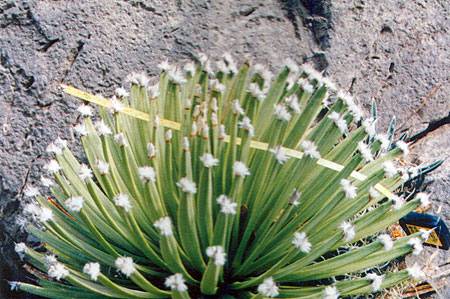
- © Ismael Cabral
-

- One of the newly named species
following the revision of the taxonomic status of agave gypsophila
belonging to the Marmoratae group (Vasquez-Garciae & Nieves
2013). Endemic to southern Jalisco.
-

-

- Sahagun & Vazquez-Garcia
2013. Endemic to Sierra de Coalcoman, Michoacan.
- One of the newly named species
following the revision of the taxonomic status of agave gypsophila
belonging to the Marmorate group.
-

-

- A close relative of agave angustiarum
belonging to the genus Littaea and the Marginatae group and described
in 2007 by Chazaro, Valencia and Vazquez. It was originally named
agave colimillensis. It grows on virtually unreachable vertical
cliffs and is endemic to the barranca of Colimilla and Rio Verde,
Jalisco. It does not produce offsets or bulbils.
-

-

-
- This is probably a provisional
name as the plant has not yet formally been described. A hybrid
between x mitis nova and ellemeetiena the plant appears to have
similarities with attenuata and pedunculifera ( Amolae group).
-


- Photos by Jeremy Spath
-

- Described by Webb & Starr in 2014 from Picachos
de Santa Clara, Baja California. It's closest relative would
appear to be agave vizcainoensis and the two form the new section
Intermediae in the author's new revision of the group Deserticolae.
It is a medium-sized species with distinctive glaucous blue-green
leaves that does not produce offsets, has a relatively short
and narrow inflorescence, and a distinctive flower structure.
This new species is a narrow endemic restricted to mostly rocky
slopes and alluvial surfaces emanating from isolated mesas and
peaks in an environment with strong fog influence.
-

- © Webb
& Starr 2014
-

- Newly described
by Greg Starr in Phytotaxa 428 (2): 073–080 92020). The
plant was first discovered in 2004 on limestone hills north of
Nizanda on the Isthmus of Tehuantepec in Oaxaca,Mexico. It belonds
in subgenus Littaea, Marginatae group). Nearest relatives are
agave ghiesbreghtii (and huehueteca) and agave angustiarum.
-

- © Greg
Starr 2020
-
- Nice photos
here: https://www.agaveville.org/viewtopic.php?f=3&t=9773&sid=b7c8ca2e0372f721606a6a4cddb37902
-

- Newly described by Vazquez &
Valencia in 2007. It was found in Tequila, Jalisco and with the
stiff unarmed leaves is thought by some possibly to be the long
lost agave bakeri, although this is no longer an accepted concept.
- Subgenus Littaea, originally
placed in group Marginatae it subsequently found itself in Amolae
(Serrulatae) and recently in section Inermes.
-

- (photo from Nick Macer)
-

- Described by
Lode and Pino in 2007 in Cactus Aventures (January 2008). The
type plant is to be found in Peru but these plants have also
been observed in Bolivia,Columbia and Ecuador. It would appear
that in the past they have been mistakenly identified as agave
americana or agave americana v. expansa. One of the characteristics
of this plant is the inflorescence which is bent and grows almost
horizontally in a comma shape. Subgenus Agave.
-

 Habitat photos from Peru by Helmut Wendenburg © 2008

Described in March 2018 by Greg Starr, Etter and Kristen (Cactus and Succulent Journal 90(1):39-45 ). It is a small-sized species in the  subgenus Littaea and the Striatae group  and is endemic to Cerro las Flores on the Isthmus of Tehuantepec
 in southern Oaxaca. Closely related to agave dasyliriodes, agave kavandivi and agave stricta. Gentry's original Striatae section (1982) consisted of agave striata, stricta and  dasylirioides ( now reverted to agave dealbata), none from Oaxaca,
but subsequent research has produced  6 new species ( albopilosa; gracielae; kavandivi; petrophila; rzedowskiana and tenuifolia) .


Described in November 1922 by Starr and Davis (Cactus and Succulent Journal 93(4):273-285 ) this plant had long been confused with agave tenuifolia but field studies revealed morphological differences which gave it separate status.
It grows in Nuevo Leon and Taumalipas. There are also strong similarities with agave striata. Subgenus Littaea and Striatae group.
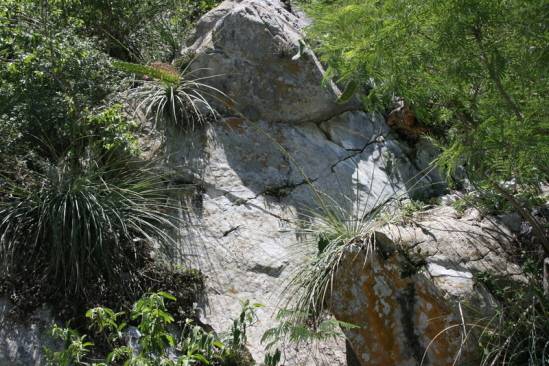
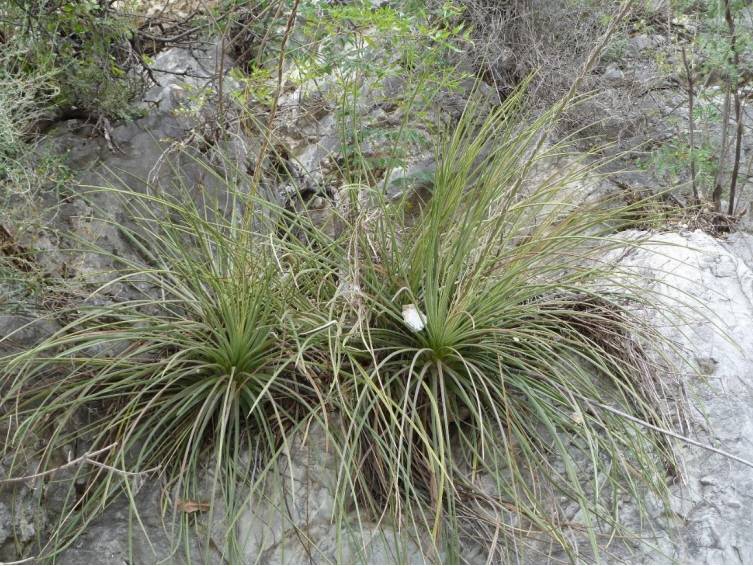 Photo; M.Greulich

Described by Vázquez, Nuño & Campos in 2023. The plant is endemic to Cabo Corrientes, Ixtlahuahuey in Jalisco. Group Filiferae.
- Agave schidigera
in the last few years has been considered a subspecies of agave
filifera alongside agave multifilifera. In September 2021 Vazquez
and Rosales carried out a revision of the schidigera complex
, a huge variety in the complex noted by Vazquez-Garcia rt al
2007. A new paper from Vasquez-Garcia et al. from August 2023
(Bol. Nakari 2023, 34(1): 1-30 ) suggests that cualensis, marcelinoi
and sororum are distinct entities and elevated to species level,
based on morphological differences from schidigera .


From Sierra El Doctor, part of the Sierra Madre Oriental in Queretaro, Mexico. Described by Hernandez-Sandoval and Magallan-Hernandez in 2014; it comes within the  subgenus Littaea and the Marginatae group and is related
 to agave glomeruliflora and agave montium sancticaroli. It has some use locally in the production of aguamiel and pulque.


Described by  Hernandez-Vera,  Vazquez-Garcia , Padilla-Lepe & Nieves-Hernandez in 2019 (Phytotaxa 422 (2): 273–288) this species is endemic to the Chorros del Varal State Reserve, at the southern border of the states of
Jalisco and Michoacán, México. It belongs to the subgenus Littaea and to the Marginatae  group and is morphologically similar to agave angustiarum and agave impressa.

Newly described in 2019 by Garcia-Mendoza & D. Sandoval in Acta Botanica Mexicana 126: e1461  |  2019  |  10.21829/abm126.2019.1461
This plant belongs to subgenus Littaea and the Choripetalae group. It is solitary with ovate, glaucous leaves with straight margins. Very closely related to agave guiengola. Found in Oaxaca in the district of Tlaxiaco.
 (photo UNAM)

- Discovered in 2004 and subsequently
described by Chazaro-Basanez and Jimeno-Sevilla. It is found
in a small area near Cordoba in the state of Veracruz in Mexico.
Although abundant in the locality it has a very restricted geographical
distribution. It belongs to the subgenus Littaea and the Polycephalae
group. It's closest relative is agave pendula.
-

-

- From Queretaro and San Luis
Potosi, Mexico. Described in 2013 by Galvan and Zamudio. Belongs
to the subgenus Littaea and the Striatae group and is related
to agave dasylirioides (now dealbata), agave petrophylla and
agave rzedowskiana
-

-

- Vazquez-Garcia, J&M Kristen
and Rosales-Martinez (Phytotaxa 564(2):208-220 in September 2022)
describe this new species from Choritepalae group in subgenus
Littaea. it is morphologically similar to but larger than
- agave gypsicola
-

- Described in 2013 by Chazaro-Basanez
and Vazquez-Garcia (Phytotaxa 134(1): 55-57, ills., 2013) this
plant was found in Totonacapan, Veracruz. Belonging to the subgenus
Littaea and the Polycephalae group it is closely related to agave
gomez pompae, but differs mainly being smaller.
-

- Newly described by Garcia-Mendoza
and Chavez-Rendon (2013) this species is from from Oaxaca and
very closely related to agave dasylirioides (dealbata) . Subgenus
Littaea and the Striatae group.
-

-

- One of the newly named species
following the revision of the taxonomic status of agave gypsophila
belonging to the subgenus Agave and the Marmoratae group. (Vazquez-Garcia
& Chazaro-Basanez 2013). Found in Michoacan.
-

-

- Newly named species by Garcia-Morales,
García-Jiménez & Iamonico in Novon, A Journal
for Botanical Nomenclature Vol. 27 nr. 4 (2019). Found in Taumalipas,
north eastern Mexico and morphologically similar to agave tenuifolia
& agave striata. Subgenus Littaea and the Striatae group.
-


- Newly described in 2019 by Garcia-Mendoza
& S.Franco in Acta Botanica Mexicana 126: e1461 | 2019 |
10.21829/abm126.2019.1461
- Belongs to subgenus Agave and
the Ditepalae group. It is found In Oaxaca and Puebla, in the
Valley of Tehuacan. It is related to agave palmeri but smaller,solitary
and with an open rosette. It is found in the vicinity of agave
karwinskii, kerchovei, marmorata and potatorum and known to be
used in the production of mezcal.
-

- (photo UNAM)
-

- A new species from western Mexico
is described by Cuevas Guzmán, Santana-Michel, and Balcazar-Medina
in Brittonia 64(3):330-335, 2012.
- It is an endemic species from
the high altitude mountains of the Sierra de Manantlán
in western Mexico, only found at high elevations between 2640
to 2865 m on near vertical cliffs with constant fog during the
rainy season.
- The species belongs to the subgenus
Littaea and the Amolae group but according to post Gentry classifications
to the Serrulatae group ( alongside attenuata, chrysoglossa,
gilberti, nizandensis, ocahui, pedunculifera, vasquezgarciae
& vilmoriniana).
-

- (collection of Jos
van Roosbroeck)
-

- Photos by kind permission of
Jeremy Spath ©
-

- Described by
Vázquez & Padilla Lepe in 2023. The
plant is endemic to .El Diente, Sierra de San Esteban, Zapopan,
Jalisco. Subgenus Littaea and the Group Filiferae.
- Agave schidigera
in the last few years has been considered a subspecies of agave
filifera alongside agave multifilifera. In September 2021 Vazquez
and Rosales carried out a revision of the schidigera complex
, a huge variety in the complex noted by Vazquez-Garcia rt al
2007. A new paper from Vasquez-Garcia et al. from August 2023
(Bol. Nakari 2023, 34(1): 1-30 ) suggests that cualensis, marcelinoi
and sororum are distinct entities and elevated to species level,
based on morphological differences from schidigera .

- A newly described
species by Arzaba-Villalba, Chazaro-Basanez & Viveros-Colorado
in Phytotaxa 360 (3): 263–268 ; 2018.
- It belongs to
the subgenus Littaea and Polycephalae group. This new species
comes from the Sierra de Monte de Oro, relatively low mountains
near the coast of the Gulf of Mexico ; it occurs on a volcanic
substrate in the tropical oak forest of the coastal plain of
Veracruz in eastern Mexico. It is very similar to agave pendula
with similar but shorter lanceolate to oblong leaves with a central
yellow stripe. The shorter leaves have a continuous reddish margins
,larger teeth and a thicker terminal spine. The flower stem and
flowers are also smaller in measurements.
-


- Magnolia Press
2018 ©
-

- A new species
in the subgenus Littaea and Amolae group [ section Inermes] endemic
to the state of Jalisco. Described by Vazquez-Garcia et al. November
2022 . Agave martaelenae is similar to agave pedunculifera but
sufficient morphological differences described enable it to be
treated as a separate species.
-

- Newly described
species by Vazquez-Garcia ( Phytotaxa 616(1):99-106 ;November
2023) . Agave mayo is endemic to the Sierra de Barobampo, Sinaloa,
Mexico. This species shares morphological characteristics with
A. schidigera but
- enough differences
are described to enable it to be treated as a distinct species.
Sugenus Littaea and the Filiferae group.
-

- Newly described
in 2019 by Garcia-Mendoza & Sandoval in Acta Botanica Mexicana
126: e1461 | 2019 | 10.21829/abm126.2019.1461
- Belongs to subgenus
Littaea and the Marginatae group. Found in Oaxaca, Silacayoapam
district, plus Puebla and Guerrero. Very close to agave xylonacantha,
is solitary in an open rosette with long leaves with a central
band.
-

- (photo
UNAM)
-

- A new species described by Garcia-Mendoza,
Jacques-Hernandez and Salazar Bravo in the Journal of the Botanical
Research Institute of Texas 1 (1):79-84 ;2007.
- It was found in 2003-04 in the
Sierra de San Carlos region, Taumalipas in Mexico. It belongs
to the Marginatae group of the subgenus Littaea and is similar
to agave X glomeruliflora (Berger) but is generally a larger
plant than X glomeruliflora with larger and more numerous leaves.
-
 ................
-

- Newly described in April 2020
by Zamudio and Gutierrez ( Brittonia, DOI 10.1007/s12228-020-09613-0\0).
Belongs to the Choritepalae group in subgenus Littaea. It is
found only in a small area in Queretaro.The stand out feature
is the inflorescence which is large and covered in purple bracts
and purple flowers.
-


-

- Agave nievesiorum is described
by Vazquez-Garcia et al. in Phytotaxa 647 (2): 144–158 (2024).
Echinoagave was formerly known as Agave Linnaeus (1753), subgenus
Littaea (Tagliabue 1816) Baker
(1888), sect. Juncineae Salm-Dyck (1861), or Group Striatae Baker
(1877), This new species is endemic to the Sierra Wixárika
(Huichola), part of the Sierra Madre Occidental, Jalisco, Mexico,
It shares morphological characteristics with (Echino)agave rzedowskiana
but differs from the latter by having narrower and striate leaves;
-

- A new species from Oaxaca described
by Garcia-Mendoza in Acta Botanica Mexicana 91:71-93 (2010).
Subgenus Agave and the Hiemiflorae group. This is accompanied
by a revision of the potatorum complex in the Hiemiflorae group.
The habitat is alongside agave potatorum and seemanniana in the
mountains of Mixteca Alta in Oaxaca, potatorum extending northwards
into Puebla. Gentry had described agave seemanniana as growing
in Chiapas and extending southwards into Guatemala,Nicaragua
and Honduras. The plants growing in Oaxaca now considered by
Garcia-Mendoza to be agave seemanniana had been assigned by Gentry
as agave potatorum,emphasising how closely related they are.
- The new species differs from
agave potatorum in the shape of the inflorescence and minor leaf
differences. Agave nussaviorum coexists with A.convallis(?kerchovei);
A.atrovirens; A.salmiana and A. angustifolia.
-

-

- The above notes apply also to
v. deltoidea, which is distinguished by the larger deltoid shaped
leaves. It's habitat is also different, being at a higher altitude
and consisting mainly of volcanic rock.
-

 Jos van Roosbroeck collection

Described by Starr & Davis in 2019 (Cactus and Succulent Journal of America  Volume 91 Number 2 ) as a new species separate from agave titanota. Subgenus Littaea and the Marginatae group.
Originally seeds of this plant were collected in Sierra Mixteca in 1984 by Felipe Otero and sold as agave FO-076 (or agave sp. Sierra Mixteca and agave sp.Nr.1). Some years later seeds of agave titanota became available and it was stated
that these FO-076 were all forms of the same plant i.e. titanota. Field trips to habitat by Starr and Davis showed that although titanota and FO-076 were related there were enough morphological and geographical differences to  describe
FO-076 as a separate species. it is related to agave kerchovei and agave quiotepecensis.


- A new species of agave has been
described in SIDA Vol 20 ( 2 ) pages 495-499 in November 2002.
The authors are Greg Starr and Jose Villareal.
- The plant originates from the
Sierra de Lampazos in northern Nuevo Leon. It belongs to the
subgenus Agave and the Parryanae group. It is related to A. havardiana
and A. parrasana.
- It is considered that this plant
is the same as collected and distributed previously by Mrs Anna
Nickels as A. noah, which was never properly described or published
but Trelease in 1911 treated it as a synomym of A. wislizenii.
A.wislizenii in turn was originally considered synonymous with
A. parrasana but subsequently Ullrich in 1992 argued that it
was actually a form of A. parryi.
- Description: Agave ovatifolia is solitary (non-offsetting)
with a hemispherical rosette reaching anywhere from 2-5 feet
tall by 3-6 feet across. When grown hard, the plant will stay
on the smaller end while those grown with ample moisture will
attain maximum size. The common name, Whale's Tongue comes from
the short, wide, distinctively cupped leaf blade. Marginal teeth
are small, and the dark grayish black terminal spine is about
1 inch long. The paniculate inflorescence is 10-14 feet tall
and consists of several side branches, each densely clustered
with large, greenish yellow flowers
- Habitat and Distribution: Agave ovatifolia is found in the sierras
in northeastern Mexico. It occurs at elevations from 3,700-7,000
feet.
-

- © 2003
Greg Starr
-

- One of the newly named species
following the revision of the taxonomic status of agave gypsophila
belonging to the subgenus Littaea and the Marmoratae group. (Vasquez-Garciae,
Muniz & Padilla-Lepe 2013). Found in Colima.
-

-
- A new subspecies of agave parviflora
is described by Starr & van Devender in Cactus and Succulent
Journal, 83(5):224-231. 2011, published by Cactus and Succulent
Society of America. it is distinguished from subspecies parviflora
& flexiflora by a larger leaf size and more densly crowded
flower stalk. It was found growing east of Yecora in south eastern
Sonora. Subgenus Littaea and the Parviflorae group.
-


- © 2011
Greg Starr & Tom Van Devender
-

- Newly described form of agave
victoriae reginae from the region of south east Durango ( Acta
Botanica Mexicana 95: 65-94 (2011) ). Subgenus Littaea and the
Marginatae group.
-
- In the new article by Gonzales
Elizondo et al. in 2011 agave victoriae reginae is newly reclassified
as follows:
- 1. victoriae reginae ssp.
victoriae-reginae (western Nuevo León and eastern
extreme of Coahuila
- 2. victoriae reginae ssp.
swobodae (southern Coahuila and northeastern Durango)
3. nickelsiae (microendemic to southeastern Coahuila)
; replaces fernandi-regis
- 4. pintilla (the most
westernly distributed species in the group, restricted to southeastern
Durango).
-

- Newly described in 2019 by Garcia-Mendoza
& S. Franco in Acta Botanica Mexicana 126: e1461 | 2019 |
10.21829/abm126.2019.1461
- Belongs to subgenus Littaea
and the Marginatae group. Found in Oaxaca, Cuicatlan district
and very closely related to Gentry's agave titanota , the newly
named agave oteroi and agave kerchovei .
- Grows with agave karwinskii
as a solitary plant with long. lanceolate leaves straight margins
and variable teeth, some interstitial.
-

- (photo UNAM)
-

- A paper from Vazquez-Garcia,
Etter, Kristen & Thiede (Bot. sci , vol.100, n.3, pp.765-778.
May 2022) studied the agave ellemeetiana complex ( Choritepalae
group). This occurs as two distinct populations, ellemeetiana
ssp. ellemeetiana found in central Veracruz and northern Oaxaca
(original descriptions from cultivated European plants) and ellemeetiana
ssp.subdentata. The latter is found in Putla District, Mixteca
Alta in western Oaxaca. Studies of the flowers of agave ellemeetiana
ssp. subdentata showed that these did not match those of agave
ellemeetiana nor those of section. Choritepalae.The floral morphology
of populations of agave ellemeetiana ssp. subdentata from western
Oaxaca places this species in the Inermes group, and the set
of morphological differences is sufficient to recognize it as
a distinct species.
- The populations from the Putla
District are sufficiently distinct in their morphology and ecology
to merit recognition as a new species, agave rosalesii, placed
in the. Inermes grouping.
-
-

- A new species
of agave is described in Brittonia: vol 55, no 3, pp. 240-244
( 2003 ). The authors are Pablo Carrillo-Reyes and Raymundo Ramirez-Delgadillo
from the University of Guadalajara and Rito Alvina from the University
of Sinaloa. The species belongs to the Striatae group of the
subgenus Littaea and comes from Jalisco and Sinaloa in western
Mexico. It is related to agave dasylirioides and agave petrophila.
-

 Habitat pictures from Jalisco, México
These photos are by courtesy of and strictly the property of Pablo Carrillo-Reyes
Habitat pictures from Jalisco, México
These photos are by courtesy of and strictly the property of Pablo Carrillo-Reyes

Described in 2022 by Starr,Davis and Juarez (Cactus and Succulent Journal of America Volume 94 Number 3) this species is placed in the new section Micracanthae ( corresponding to subgenus Littaea and the  Polycephalae group).
Found in municipality of Tepelmeme,  District of Coixtlahuaca, Oaxaca. Related to agave mitis and agave chiapensis.


Described by Wendy C. Hodgson, Andrew M. Salywon and William H. Doelle in Systematic Botany, 43(3):734-740 published by The American Society of Plant Taxonomists (2018).
Found in a few sites along the San Pedro river, it has grey-green leaves with thick bases and conspicous bud printing. It appears to be sterile.
This plant has similarities to ag. phillipsiana and ag. palmeri. It is considered as a crop plant grown by the Hohokam, ancient inhabitants of Arizona between 300-1450. Agave delamateri and murpheyi
were identified as growing in ancient agricultural fields alongside a third 'mystery' plant, now identified and named as sanpedroensis, a domesticated crop. Hochstatter in 2015 created a new grouping of Hodgsoniae to cover all
the possible cultivated plants of the pre Columbian era in Arizona. This grouping seems to correspond to Gentry's Ditepalae grouping. Subgenus Agave.


Photo from Ron Parker

A new species (subgenus Littaea , Amolae group) endemic to the state of Jalisco. Described by Vazquez-Garcia et al. November 2022 . Similar to agave martaelenae ( newly described) and agave pedunculifera.

Described by Vazquez and Chazaro in 2023 (Bol. Nakari  34(1): 1-3). Found in Durango. Subgenus Littaea and the Group Filiferae.
Part of the revision of the agave schidigera complex by Vasquez-Garcia et al. from August 2023.

- First collected by Vazquez-Garcia
& Chazaro-Basanez in 2010 this new species was found in the
municipalities of Mexticacan and Canadas de Obregon in the Los
Altos region of Jalisco, western Mexico. The area is close to
the Rio Verde and threatened by the El Zapotillo dam project.
It's flowering features place it in the section Ditepalae and
there are morphological similarities with agave wocomahi and
agave durangensis. Subgenus Agave, Ditepalae group.


- A new species
from northeastern Baja California described by R.H.Webb and J.M.Salazar-Ceseña
in Brittonia, v. 63 ( 203-210); 2011.
- This solitary
species is placed in the subgenus Agave and the group Conicae
and it's closest relatives appear to be agave moranii and agave
desertii v. simplex.
- It has a very
restricted habitat on monzogranite and adjacent colluvial slopes
in the Sierras Cucapá and El Mayor.
-

- A large,robust
new species has been described in 2004 by Miguel Chazaro-Basanez
and J. Antonio Vazquez-Garcia from the University of Guadalajara
and Yalma Luisa Vargas-Rodriguez of Louisiana State University.
The plant is solitary, non suckering with dark green cross banded
leaves. It is endemic to western Jalisco and has been placed
in the Marmoratae group of subgenus Agave. It's closest relative
is Agave marmorata.
- It's local name
is maguey relisero and it is used in the manufacture of a type
of mescal called raicilla ( also known as ximat ), which is an
alcoholic tequila like beverage manufactured mainly from Agave
maximiliana in the rural highlands of western Mexico. It was
the examination of wild populations of this maguey relisero that
led to the realisation that these plants were not identifiable
with any currently known species.
-

- ( from the Jos van Roosbroeck
collection )
-

- This new species
was discovered and presented as such in 2002 by Miguel Chazaro-Basanez
and Oscar Valencia Pelayo from the University of Guadalajara.
It would appear that this plant had previously been wrongly identified
as Agave pedunculifera by a number of various authors.
- This non suckering
species is found only on the northern slopes of Sierra Manantlan
in southern Jalisco,western Mexico. It belongs to the Amolae
group of subgenus Littaea. It's closest relative is Agave pedunculifera
from which it differs in having larger, firmer leaves, a larger
terminal spine plus larger flower spikes and flower parts.
-

- ( from the Jos van Roosbroeck
collection )
-

- Until recently
agave vestita was a synonym of agave schidigera, itself in the
last few years considered a subspecies of agave filifera alongside
agave multifilifera. A new paper from Vasquez-Garcia et al. from
August 2023 suggests that vestita is a distinct entity and elevated
to species level, based on morphological differences. The schidigera
complex is further split withe the addition of three new species,all
based on morphological differences. These are
- agave cualensis,
agave marcelinoi and agave sororum. Subgenus Littaea and the
Filiferae group.
-
-

- Newly described by Hodgson &
Salywon in 2013. Found in central Arizona,close to archeological
sites, suggesting it could be a 'domesticate' or clone thereof.
No close relatives, but some characteristics of ag. delamateri,
chrysantha and shrevei. It has been provisionally placed in Ditepalae
group of subgenus Agave.
-

- (courtesy of Ron
Parker)
-

- Newly described by Hodgson &
Salywom in 2013. See notes for agave verdensis above as these
apply also to this plant.
-

- (courtesy of Ron
Parker)
-

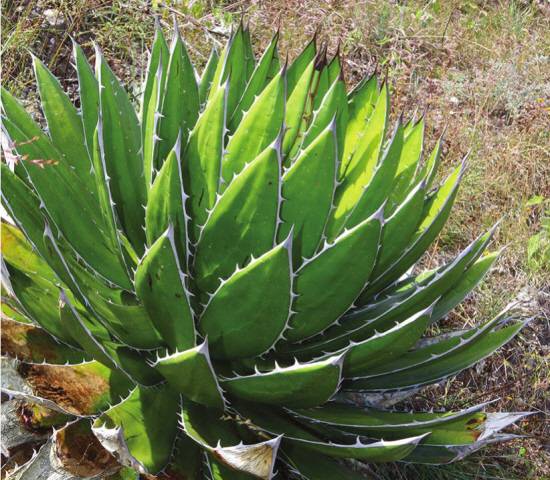
- A new species from the Marginatae
/ Heteracanthae group described by Starr & juarez Garcia
in 2024. The plants had been first spotted by Spath & krock
in 2019 ,matching no known species and confined to one gypsum
hill in San Bartolome Yucuane in Oaxaca. They are related to
horrida, garciae-mendozae, convallis and perotensis but differ
in morphology in having more leaves , longer infloresence and
larger rosettes.
-
-
-
- Subgenus
Littaea :
Important
changes proposed since Gentry (1982) :
-
- Agave angustifolia is renamed as Agave vivipara ( Wijnands
1983 ; Foster 1992 ; Smith & Steyn 1999). This name change
was included by Dr. J. Thiede in his contribution to 'Handbook
of Succulent Plants : Monocotyledons' published in 2001. The
name change appeared not to be universally accepted and in 2003
Garcia-Mendoza & Chiang produced a paper in Brittonia in
which they argued that angustifolia and vivipara are separate
taxa and should not be considered one and the same plant.
Agave capensis is reduced to A.aurea v. capensis
by Webb & Starr (2015)
-
- Agave convallis ( Trelease 1920) was treated by Gentry
in 1982 as a synonym of agave kerchovei and part of the kerchovei
complex.. However based on morphological differences Garcia-
Mendoza in 2011 elevated it to species level. He also transferred
agave dissimulans (Trelease 1920) from being a synonym of kerchovei
to a synonym of convallis.
Agave deserti ssp. pringlei (Engelmann ex Baker)
Gentry becomes A. deserti var. pringlei (Engelmann ex Baker)
and Agave deserti ssp. simplex (Gentry) becomes A. deserti var.
simplex (Gentry) i.e. the two subspecies Gentry recognized under
A. deserti are reduced to variety status ( Hodgson 2001 ) :
In 2015 Webb & Starr wrote an article 'Gentry Revisited:
The Agaves of the Peninsula of Baja California, México
( Haseltonia 20(20):64-108 · February 2015 ) in which
several nomenclatorial changes were proposed. These included
the reversion of A.desertii v. pringlei to the original A. pringlei
(Engelmann ex. Baker).
Agave desertii ssp. simplex seems more closely
related to agave mckelveyana and subsimplex than desertii and
so on review it was decided that A. deserti subsp. simplex warrants
recognition at specific level, thus the new combination Agave
simplex (Gentry) Salywon & Hodgson, comb. et stat. nov.,
is proposed ( Salywon, A.M. and W.C. Hodgson. 2019. Agave simplex,
a new combination for Agavaceae. Phytoneuron 2019-219: 1–4.
Published 25 April 2019 ).
- Agave dissimulans (Trelease 1920) was treated by Gentry
(1982) as a synonym of agave kerchovei and part of the kerchovei
complex. Although there were morphological differences it was
related to kerchovei and convallis. It was deemed distinct enough
for Smith et al. (2018) to elevate it to species level.
Agave gypsophila was described in 1982 by Gentry
as a single entity in the group Marmoratae. In 2013 there has
been a taxonomic status revision by Vazquez-Garciae, Chazaro-Basanez
et.al. (Systematic Botany (2013) 38(2): pp320-331) and now gypsophila
is considered not as a single entity but a gypsophila complex
consisting of five species, four being newly named species.
1. Agave abisaii (Vazquez-Garciae & Nieves 2013) from southern
Jalisco
2. Agave andreae (Sahagun & Vasquez-Garciae 2013) from Michoacan
3. Agave gypsophila (Gentry 1982) from Morelos,Guerrero
4. Agave kristenii (Vasquez-Garciae & Chazaro-Basanez 2013)
from Michoacan
5. Agave pablocarrilloi (Vasquez-Garciae, Muniz & Padilla-Lepe
2013) from Colima
-
- Agave horrida ssp. perotensis has been elevated to species status
as agave perotensis by Starr & Juarez Garcia (2024)
Agave macroculmis (Todaro) as assigned by Gentry
to wild plants in habitat is now considered incorrect
( he himself had doubts;see 'Agaves of Continental North America'
p.601 ) and Todaro's plants have been identified as a form of
A. atrovirens.
The wild plants that Gentry gave this name to are now considered
as a new species and named A. gentryi (Ullrich 1990b)
This thread developed a few years later when the name agave montana
was given to plants growing together with and at higher altitudes
than agave gentryi. Subsequently in some locations plants of
gentryi were also found at the higher altitudes. There is currently
sharp debate as to whether these are entirely separate entities
or if hybrid or intermediate forms exist. There are differences
in inflorescence characteristics between the two species.
-
- Agave neomexicana was reclassified as a subspecies of
A. parryi ( Ullrich 1992) :
Agave parryi v. couesii / huachucensis / truncata were
all reclassified as forms of A. parryi ssp. parryi ( Ullrich
1992) :
Agave promontorii is reduced to A. aurea ssp. promontorii
by Webb & Starr (2015)
Agave pygmaea reclassified as subspecies of A.
seemanniana ( Ullrich 1992c) :
Agave scabra (Salm-Dyck) as allocated by Gentry
was corrected to A. asperrima (Jacobi).
From descriptions and photographs it was shown that Salm-Dyck's
original plant was A. wislizeni (Engelmann),
nowadays considered a form of A. parryi. The name scabra had
earlier been used by another author,
Ortega in 1797, to describe a plant subsequently reassigned to
Manfreda so Salm-Dyck's use for his plant
was invalid. ( Ullrich 1992):
Agave stringens (Trelease 1920) was allocated by
Gentry to the group Rigidae and descriptions were based on immature
plants.
The plant has since been 'rediscovered' by Kristen & Etter
in near Guadalajarana, Jalisco (site of Trelease's type plant)
and is now placed in the group Viviparae, consisting of Gentry's
groups Rigidae & Sisalanae.
Agave wislizeni was reclassified as a synonym for
a form of A. parryi and no longer applicable to A. parrasana
( Ullrich 1992) :
-
-
- Subgenus Agave
: Important changes proposed since Gentry (1982)
:
Agave albomarginata from the Marginatae group and
closely related to A. lechuguilla was previously considered a
cultivar from the Huntingdon BG. It was found in Queretano (Hernandez
1994).
-
- Agave attenuata and pedunculifera regarded as part of the same variable
complex ( Ullrich 1990d) :
-
- Agave bracteosa transferred from Choripetalae group
to new Serrulatae group ( Ullrich 1990d) :
-
- Agave celsii considered as synonym for A. mitis (
Ullrich 1993a ) :
-
- Agave colimana reverts back to A. ortgesiana ( Ullrich
1991a) :
Agave ellemeetiana was originally placed by Gentry
(1982) in the group Choritepalae together with A. bracteosa and
A. guiengola. At that time habitat was unknown and the neotype
was assigned to a plant at the Royal Botanical Gardens at Kew
in London. In 1991 Ullrich placed this agave in his group Attenuatae,
considering it closely related to A. pedunculifera, now considered
a subspecies of A. attenuata.
In the C&S.J.(U.S.), nr.4 (2002) it was reported that A.
ellemeetiana has been 'refound' in Oaxaca (Garcia-Mendoza). The
form growing there has denticulate margins. In 2007 there were
reports of finding it in Veracruz and this is now considered
the main habitat of this plant. In fact in 1920 Trelease had
suggested Veracruz as the likely habitat of this species.The
specimens from Veracruz have unarmed margins and slightly longer
leaves than those in Oaxaca.
Agave felgeri transferred from Filiferae group
to Parviflorae group ( Ullrich 1991c) :
Agave fernandi-regis (Berger), a form of A. victoriae-reginae,
reverts to A.nickelsiae (Gosselin) (2011).
Agave FO-076, also known as sp. nr1,
sp. Sierra Mixteca and controversially added into
titanota, has been renamed as A. oteroi by Greg Starr & Tristan
Davis in Cactus and Succulent J., 91(2):134-143 (2019)
Agave hartmanii identified as synonym of A. parviflora
ssp. flexiflora (Ullrich 1990i) :
Agave multifilifera and agave schidigera
reclassified as subspecies of A. filifera ( Ullrich 1992 l) :
Agave nizandensis transferred from Amolae group
to new Nizandensae group ( Ullrich 1991b) :
Agave obscura is identified as synonymous with
A. polyacantha v. xalapensis ( Chazaro- Basanez 1981 and Ullrich
1992 ).
- The original
agave obscura was named by Schiede in 1830. Subsequently it was
ignored in turn by all the famous taxonomists such as Salm Dyck,
Jacobi, Baker and Berger. The name was mentioned again by Trelease,
Breitung and Gentry but appears to have referred to a different
plant ,closely related to A. horrida and named by Ullrich as
A. horrida ssp. perotensis. Schiede's original A. obscura is
considered in work by Chazaro Basanez 1981 and Ullrich 1992 as
the same plant as A. xalapensis which Gentry treated as a variety
of A. polyacantha. Ullrich further proposes that the name polyacantha
is a ' nomen confusum ' and should no longer be used.
Agave pedunculifera now considered synonym of A. attenuata
ssp. dentata ( Ullrich 2006)
Agave stricta reclassified as subspecies of A. striata ( Ullrich
1990b ; 1991d) :
Agave warelliana, belonging to the Polycephalae
group, found for the first time as a wild plant at the Pico de
Oriba volcano in Veracruz . Found also at La Trinitaria, Chiapas,
Mexico by Garcia Mendoza and in Guatemala ( Garcia Mendoza &
Lott 1994 ) . Previously the plant had been described by Baker
from a specimen at the Reigate collection of Mr. Wilson Saunders.
The neotype specimen had been designated by Gentry in 1982 from
a plant from the Hanbury Gardens at La Mortola prepared by Berger
in 1912.
